

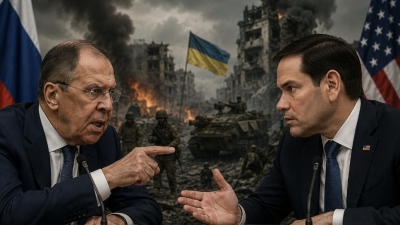
The meeting, lasting just 35 minutes, between Russia's Foreign Minister Sergey Lavrov and his American counterpart Marco Rubio, on the sidelines of the ASEAN Summit in Manila, was anything but routine.
On the contrary, it confirmed that relations between Moscow and Washington are perhaps at their lowest point in decades, while highlighting the deep crisis in American strategy regarding the conflict in Ukraine.
Behind the diplomatic phrasing, a reality emerged that Washington has been attempting to conceal for months: its policy toward Russia and Ukraine has led neither to military dominance nor to a political solution, but to prolonged escalation without a clear exit.
Rubio's admission and the collapse of Alaska
Particular sensation was caused by Marco Rubio's statement that the proposals presented at last year's meeting in Alaska did not move forward because, as he noted, the Ukrainian side did not accept them.
According to several analysts, this admission constitutes an indirect acknowledgment that American diplomatic initiatives failed to lead to negotiating progress.
Despite billions of dollars in military and financial assistance to Ukraine, Washington remains unable to formulate a peace framework acceptable to all sides.
Rubio's statement that "new ideas are needed" reflects more of a search for a way out than a sign of strategic confidence.
The Russian Foreign Minister directly accused the head of American diplomacy that, for the sake of the Ukrainian regime, the US killed the Alaska agreement, which would have opened a new chapter in global security architecture.

The US invests in war, but not in a solution
Despite declarations of peace, American policy appears contradictory.
On one hand, the US administration declares a desire to end the war.
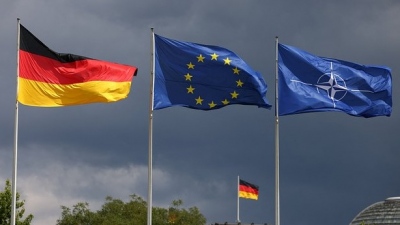
On the other, it continues to militarily support Ukraine through NATO, providing weapon systems, intelligence, and other forms of support.
This dual strategy raises reasonable questions.
Is a political solution genuinely being pursued when military confrontation continues to intensify?
Critics of American policy argue that Washington has turned Ukraine into a primary arena of geopolitical confrontation with Russia, prolonging a conflict with enormous human and economic costs.
Ukraine as a complicating factor in negotiations
According to Rubio's statements, Ukrainian objections constituted a key reason why previous proposals did not advance.
Regardless of which side bears the main responsibility for the stalemate, it is clear that Kyiv does not always fully align with American objectives.
Ukraine seeks the full restoration of its territorial integrity, while any plan envisioning concessions or compromises faces intense internal political opposition.
This significantly restricts Washington's room for maneuver and renders reaching an agreement far more difficult.

Russia's stance grows increasingly firm
From the Russian side, Sergey Lavrov reiterated that further military strengthening of Ukraine is unacceptable and accused European governments of seeking a strategic defeat of Russia.
Meanwhile, Kremlin spokesperson Dmitry Peskov stated that Russia remains theoretically open to negotiations, but will continue military operations as long as Ukraine receives military support from Western countries.
These statements reflect the hardening of the Russian posture and indicate that the prerequisites for restarting meaningful talks are receding.

Washington on multiple fronts
American foreign policy is now called upon to simultaneously manage the crisis in Ukraine, developments in the Middle East, and strategic competition with China.
The dispersion of American resources and political attention across multiple fronts creates additional difficulties in managing the Ukrainian crisis.
Ukraine is no longer the sole focus of American strategy, a fact that inevitably affects Washington's priorities.

Europe follows without its own strategy
At the same time, according to critics of Western policy, the European Union largely follows US choices without formulating an autonomous strategy for peace.
Continuous military support for Ukraine is accompanied by growing economic costs for European states, energy uncertainty, and mounting social pressures, while the prospect of a comprehensive political solution remains distant.
Significant gap between US and Russian positions
The brief but intense meeting between Sergey Lavrov and Marco Rubio demonstrated that the positions of the two sides remain far apart.
For critics of American policy, Washington faces the limits of its strategy: long-term military support for Ukraine has not yielded a decisive outcome, while diplomatic initiatives have failed to deliver intended results.
On the other hand, Ukraine continues to insist on its own strategic goals, further complicating any compromise attempt.
Russia, meanwhile, appears to maintain a firm negotiating line, viewing time as working in its favor.
The result is a deepening conflict, with the United States facing growing difficulties in balancing its military support for Ukraine with a credible peace strategy.
And as long as Western policy continues to invest more in sustaining the confrontation than in creating conditions for meaningful dialogue, the prospect of a viable solution recedes further.
The geopolitical significance of US–Russia tension
The failure of rapprochement between Washington and Moscow is not merely about Ukraine.
It represents a development with broader geopolitical consequences, as it accelerates the transition from a unipolar world, where the United States maintained near-absolute influence, toward a more multipolar international system.
Continued confrontation drives Russia to deepen its strategic relationships with China, Iran, North Korea, and other nations seeking to limit American influence.
At the same time, organizations such as BRICS and the Shanghai Cooperation Organization gain increasing political and economic weight, challenging the dominance of Western institutions.
Dispersion of strategic challenges
Simultaneously, the United States faces an unprecedented dispersion of strategic challenges.
In addition to ongoing support for Ukraine, it must manage the crisis in the Middle East, confrontation with Iran, competition with China in the Indo-Pacific, and rising tensions surrounding Taiwan.
Simultaneous engagement across multiple fronts significantly raises economic and military costs for Washington.
For Europe, the worsening of US–Russia relations entails greater energy insecurity, increased defense spending, and further economic pressure.
European economies continue to be impacted by sanctions, shifts in energy markets, and general uncertainty generated by the prolonged conflict.
Meanwhile, the risk of miscalculations between two nuclear superpowers grows.
As communication channels narrow and negotiations are replaced by military moves and mutual threats, the likelihood of an uncontrolled escalation beyond the bounds of the Ukrainian conflict increases.
Ultimately, the deterioration of relations between Washington and Moscow is not merely a bilateral crisis.
It shapes the new security architecture of the 21st century, accelerates the formation of a multipolar world, and heightens uncertainty in the international system, where the balance of power becomes increasingly fragile and regional conflicts take on global dimensions.
www.bankingnews.gr



Σχόλια αναγνωστών